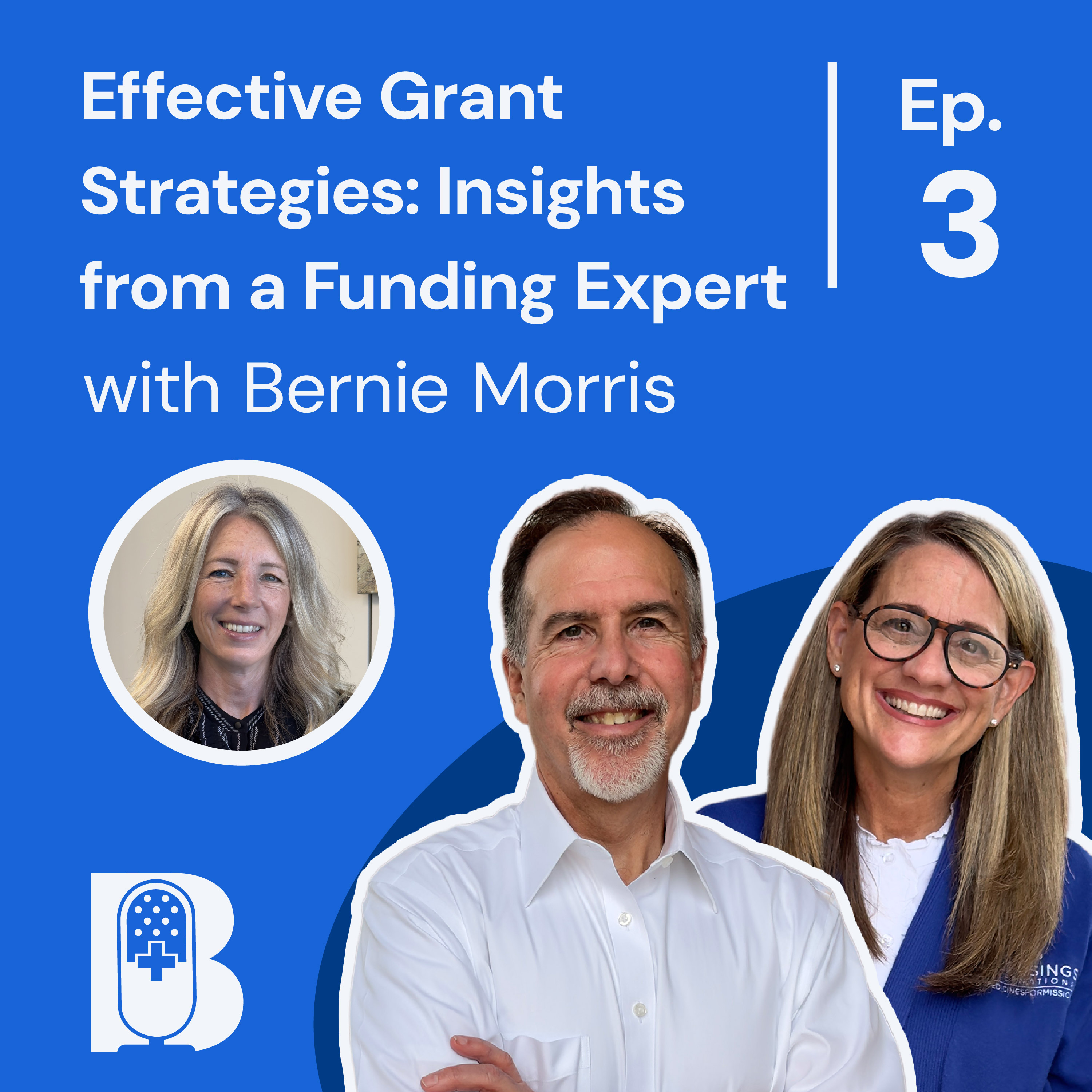
Barry Ewy:
Excited that Bernie's agreed to join us on the podcast and share some of the information that she has from being in that role of an executive director with a granting foundation. We're just going to jump right in, Bernie, and start asking questions. Is that all right?
Laura Berry:
Welcome to the pod, Bernie.
Bernie Morris:
Thank you. Glad to be here.
Barry Ewy:
Okay, so you know, first, I think there's a lot of different ways to get funding. You know, some organizations may think, hey, there's only this way because that's what they do. Or they may think, well, there's only this way because that's what they do. But there's a lot of different ways to get funding. So if you could, just share with us kind of an overview of fundraising. Like what are some of the different ways organizations can gain funding?
Bernie Morris:
Yeah, I'd be glad to answer that. So first you have your individual donors, which a lot of ministries just have specific individual donors. Sometimes you might have corporate donors. Those are good ways to raise funds. But then also there's events, and that can look like anything from like a banquet or a gala to a bake sale. And the only reason I mentioned bake sale is because I remember in March of 2022, when the Ukraine war started, there was a church in Kentucky raised $145,000.
Laura Berry:
Wow.
Bernie Morris:
From a bake sale.
Barry Ewy:
That's a lot of cookies.
Bernie Morris:
That's a lot of cookies. I think they had 2,000. So maybe not that many cakes or cookies or whatever, but they really had a lot of funds come out of that. So not to neglect some of those things that you might think would be smaller in profit. Now, am I guaranteeing $145,000 from cookies? No, but it's still, you know, it's still an option like yard sales.
Barry Ewy:
Some of it may be based on the scale of the organization as well. So if you're just needing a couple thousand dollars to do whatever you're gonna do, something like a bake sale or some other kind of local small fundraising like that might be appropriate. If you're needing half a million dollars for your project…
Bernie Morris:
Probably not the bake sale.
Barry Ewy:
Probably not the bake sale. No. Okay, well, great.
Bernie Morris:
And then also grants. And those can be local, they could be private, they could be government. So a lot in the I guess grant making landscape in terms of fundraising. S
Barry Ewy:
So with public grants, are those difficult to get and are they difficult to deal with, especially like with Christian organizations?
Bernie Morris:
I think so. I think a little bit more difficult once that faith component is expressed. Some foundations and some public grantmakers don't have that as a funding priority, in fact, exclude that from their eligibility criteria. So that could be a dissuader for sure.
Barry Ewy:
Some really good information.
Laura Berry:
Yeah, it's really helpful to just kind of know just the lay of the land and providing that foundation for our listeners to understand sort of where we're going with this interview. But from a foundation's perspective, what signals that a ministry is trustworthy? That's just so seems like it would be so very difficult. But if you can just lend up, you know, lend us some understanding of how you allow that to be part of the big equation.
Bernie Morris:
Great question, Laura. I function as a grant officer at times. And so I'm looking to see, you know, is this organization credible? A lot of times that's their financial background. And sometimes organizations will be a little bit newer. And so they may not have longstanding history of secure financials that they can offer up. So then we look at leadership. What does their leadership in the organization look like? What's their mission look like? So I think they're ready when they have some solid finances and strong leadership.
Laura Berry:
Is there a common mistake that you see through that process? You're like, gosh, I keep seeing this over and over again.
Bernie Morris:
Sometimes organizations won't be ready, but maybe they don't know that they're not ready.
Barry Ewy:
Yeah, it seems like organizations, a lot of times when they're when you're within your own organization, it's hard to see how others outside may perceive. And so you may think everybody should see us as ready to fly and we're really not, but we can't see that yet. And I don't mean that about we us at Blessings International. I mean we as a global we.
Bernie Morris:
But that's great though, to have someone else's perspective and I don't want to jump too far ahead, but certainly when you're submitting a grant application or you're about to submit a grant application, that's a great step is to have some external eyes view what you're submitting because you are a little bit narrow minded or have a little bit of tunnel vision because you're inside the organization, like you said. So not to get too far ahead, but yeah, that would be a good step is to have another set of eyes review your grant application.
Barry Ewy:
You were saying that it's really important to look at financials, look at leadership of the organization. Do you ever feel like there's risk in what has been submitted to you that maybe what they're presenting isn't really there? So let's say their financials look potentially really good, but they're only a year-old organization and you're really wondering how could you have this good a financials or this solid of financials with not history?
Bernie Morris:
I don't think I've come across that necessarily, but there are times where you're looking at something, you're reviewing it and you're wondering, okay, is this actually what's happening? Is there a little spin on it? And so I will look and on Facebook or what other social media platforms they have is what they're presenting to me inwardly also what they have facing outwardly to make sure there's consistency in presentations.
Barry Ewy:
Yeah, because they might want to kind of beef things up, make themselves look a little better than they are so that they get what they need in order to do their programs.
So what are some important aspects that an organization should include when they're doing grant writing?
Bernie Morris:
You'll want to include the problem. So, what is the issue that you're trying to address? You'll want to include the solution. What does that look like? And maybe some impact measurements. It's also a good idea, especially if you're applying for a grant through a foundation, you'll want to know what their eligibility criteria is and what's excluded. So if there's things that are excluded and you've got a certain program or project, make sure it's not in the exclusion because you'll automatically be dismissed. And then if there are funding priorities that they have and you know what they are, make sure your program or project that you're applying for includes specific eligibility criteria in your program.
Barry Ewy:
So there may be a foundation that's got a grant that they're saying, “We've got this available,” but in their details of the organization, are you saying that some, maybe they exclude healthcare. They don't want anything to do with healthcare. So you should know that before you get into the grant application. So otherwise you're doing a lot of work for no return.
Bernie Morris:
Exactly. There may be a little bit of return because the good thing about foundations is a lot of them will have some evergreen things that they're asking for, like documents. So even though you may have applied and there's not going to be any outcome from that particular foundation, the work that you've built, you can save it and probably reuse some of those components.
Barry Ewy:
In your experience with grant applications, do they usually walk the requester through the information that's needed pretty easily? Or is this something that the potential recipient just has to create out of the blue? Because you said there's things that are needed, like what the problem is and what the solution is. Are those already asked for in the application usually? Or is that just something you should know to be sure to include?
Bernie Morris:
For our foundation, we have a grant management software, and I think most foundations do. There's fixed questions that are very specific. So you're answering those directly. And then sometimes they'll want maybe a letter of intent beforehand. That's very common. We don't require ones. Foundations require a letter of intent.
Barry Ewy:
So as you say, what would be a letter? What what's in a letter of intent?
Bernie Morris:
Letter of intent is basically what I just shared. So you're stating the problem, you're stating the solution, how you intend to solve it, maybe some ways that you can measure it. A lot of times some letters of intent will also have historic impact, or this program has been successful in this region. And then finally, an amount. Here's what I intend to ask for. And this is what I intend to use the funds for.
Barry Ewy:
So you want $140,000 to make cookies?
Bernie Morris:
$140,000 for cookies. Yes.
Laura Berry:
Sounds like those cookies are going to go really far.
You know, with that in mind, are there any components that a grantee should not include? Like is there something that you're like, gosh, I've seen this mistake over and over again. This is something that shouldn't be included. And we want our audience to know as they, you know, try to put together a grant, we want to be able to provide some wisdom.
Bernie Morris:
Right. So I think the biggest hiccup is that maybe for all of us in life, we tend to be long-winded. And so in some applicant’s mind, the longer I get, the better the grant is. And that's not true. You can be succinct and still voice your impact and your cause in a way that resonates with the foundation.
Barry Ewy:
It almost sounds like there's some people who think if I write two pages on this one area, well they're not gonna read it, but they're gonna think it's so important that it needed two pages, I'm just gonna get the money.
Bernie Morris:
Maybe so. But that's not the truth. We absolutely look at them and read them and wanna know the fine details. And so the longer the grant application is or the longer you go on for, the less likely we are to maybe feel connected to it because it just seems like it's—
Laura Berry:
Do you all cap the number of words that they can put in the software? So yes, if it's a five 500 word maximum, you are capping it at some point in that software.
Bernie Morris:
We have character limits for each section. We do have an optional upload. I mean, personally, I like to shepherd everyone through the process and position them as favorably as possible for a great review. And so if there's someone where I feel like this really isn't enough characters for them, let's not limit them. I do give them a hack. Gotcha. So this is a hack for the audience.
Laura Berry:
Here's my personal email. No.
Bernie Morris:
There's if there is an optional upload, you may be able to expand a little bit further beyond whatever the character limitation is.
Barry Ewy:
So I think you kind of already answered this, but maybe there's more. Are the things that people might think are important to be included in a grant request, but they really aren't actually helpful?
Bernie Morris:
Yeah, I think I'd go back to the longer is better. People can say something succinctly with impact and feeling. Be short. And to the point. Because sometimes there's a lot of applicants being reviewed on a docket. Some foundations only meet twice a year. So you're looking at, I mean, twenty, forty grant applicants that could be reviewed, maybe longer. And so shorter and sweeter.
Laura Berry:
So yeah, so it makes me wonder how can leaders shift their mindset from asking for money, and maybe they think, you know, if I'm just long winded enough, they're gonna give it to me, to inviting you all into a partnership. So looking at it as more of a partnership. What are ways that these leaders can shift that mindset? So with words and you know, maybe in in their interview with you and as you mentioned that you shepherd them through the process.
Bernie Morris:
Rather than fundraising just being a task?
Laura Berry:
Right. Right.
Bernie Morris:
Yeah, I think from my perspective, it's an invitation to expand the kingdom of God alongside them. So if our foundation has money and they have a need, but together we're collaborating to expand the kingdom of God. Now our foundation is faith-based and Christ centered and focused on that. Maybe others that aren't faith based; could just think of it as like a humanitarian effort rather than just throwing money towards something or viewing, I guess, the foundation being viewed as a ATM.
Barry Ewy:
Do you all view your grantees as partners?
Bernie Morris:
To an extent.
Barry Ewy:
Yeah, I mean obviously you're not completely aligned because you're working with many different organizations doing a lot of different things. But is there a mindset with foundations that they kind of consider themselves a partner? They're at least in this one task, they're aligned together to bring whatever the outcome is, rather than just as you said in ATM just saying, Hey, here's your money, go. Good luck to you; be on your way.
Bernie Morris:
It probably depends on the corporate culture of the foundation. For us, I prefer a little bit more relational than transactional relationship with the ministry. We have discovery calls. So I either want to see someone on a computer screen. I mean, I'd rather see them face to face if they're local, but that doesn't always work out. Or see them on Zoom, even if they're in Angola. And we've had that before. So for me, it is it is a little bit more relational.
Barry Ewy:
Yeah, so you're create you you're trying to create a relationship even before their grant has been fully reviewed.
Bernie Morris:
Absolutely.
Barry Ewy:
So you mentioned this a little bit ago with leadership, or I just mentioned it in the question. So I want to kind of circle back to that. early on you'd said that if an organization didn't have financials, then you would maybe look to leadership as far as determining their, I'm gonna say their credibility. I don't know if that's the best word, but that's the word I'll use. How important is leadership character in funding decisions?
Bernie Morris:
I think it's immensely important because even before we get to that funding decision, there'll be a discovery call, there'll be an invitation to apply for a grant. And so if there's not solid leadership, that invitation may not be extended. And that has happened before.
Barry Ewy:
So from a foundation's perspective, what does solid leadership look like?
Bernie Morris:
That's a great question, Barry.
Bernie Morris:
Thank you, Bernie.
Bernie Morris:
Put a lot of thought into that one. I think strong character.
Barry Ewy:
And okay, then I'm gonna ask in another follow-up. How do you gauge strong characters it by the way they answer things, by the way they presented themselves? And because to me, I would that's just that it's like you know it when you see it. But it's there's still you still have to put something to it.
Bernie Morris:
It's so subjective. I think during that initial time where we're cultivating a relationship, get a pretty good sense of the organization, their mission, their corporate culture, their leadership.
Laura Berry:
Do you think there's a specific question that like sort of fleshes out a characteristic that might be problematic or might be a benefit? You know, there might be a particular, you know, this is a question during that discovery process, that really helps me to see behind the veil. Who are they exactly? Because I think to your point, it's like sometimes it's easy to present a certain way, but at the end of the day, is this really or is this really who you are? Is this authentic? Any advice that you give for our listeners to know when… You know, they're coming forward and they're asking for funding or to be in this partnership together to really be able to present authentically who they are.
Bernie Morris:
I think transparency is big. What are they working on? What are their current plans? What have their past successes been?
Barry Ewy:
As a nonprofit or NGO, transparency should be something they're very willing to share.
Bernie Morris:
Not you would think that, but you'd be surprised at people that apply for grants and say, “It's our policy not to share.”
Laura Berry:
You mentioned you have some pretty wild stories.
Bernie Morris:
I've got some wild stories, yeah. So that's interesting from my perspective to ask for funds but not want to have that level of transparency.
Barry Ewy:
That is very interesting.
Bernie Morris:
But it's happened.
Barry Ewy:
So that would certainly be a turnoff then. That would be if there's something that would flag a request as a no, that lacking a level of transparency or ask you asking for information and they say, Well, I'm gonna get it to you.
Bernie Morris:
Right. Or it's our policy as an organization that we don't share financials externally. Which it's very interesting to me to think you're gonna put in a request for financing, but then not share transparently.
Barry Ewy:
Yeah, you it may make you want to say, you know what, we're not gonna share our financials either.
Laura Berry:
Certainly seems like a red flag to me. Yeah, gosh, I guess that the work can get complicated at times.
Bernie Morris:
It can.
Laura Berry:
Well, how can ministries communicate impact without losing spiritual authenticity. You know, I think there's a there's a delicate balance there. Like you said, they need to share this is exactly what we need, why, present the problem. But how are you guys able to discern that spiritual authenticity? I think it's a difficult question, so I imagine our leaders would like to know kind of how to present themselves when they're asking for funding.
Bernie Morris:
For us, we have a specific question on our grant application that says, you know, tell us a little bit about the spiritual component to this project, programming, operations, or whatever this request is for. And so I think applicants really need to share the spiritual transformation component of what they're doing so that there's a good sense, at least from our foundation, of how does this fit into our funding priorities on the spiritual side. But it can be tricky when you're very impact oriented and maybe you're just thinking in numbers. And so it's nice to have that data that's not just quantitative. Yes, we're going to impact fifty people this year or this month, but also what are we doing qualitatively? Explore that qualitative side. But remember the character limits.
Barry Ewy:
So some of the foundations that would be approached by our listeners yeah might not be faith-based. So let's say just a secular general grant grantor. If they're a faith-based organization, would you recommend that they try to avoid a spiritual component to what they're doing or include it?
Bernie Morris:
You're saying if they're approaching a foundation that is faith-based but doesn't exclude faith-based organizations that they know of.
Barry Ewy:
Correct.
Bernie Morris:
I would include it. Because then you'll know straight away if that's not a funding priority for that particular foundation and what you're doing is faith-based, then you all are not aligned. And so then you just know and you've been transparent, rather than coming back and you go to reapply and something comes up. And then the foundation is like, “We didn't know that that's what you were doing.”
Barry Ewy:
Well, and I would also guess that if it's a faith-based organization, you don't want them to lose their purpose just trying to get money.
Bernie Morris:
Exactly.
Barry Ewy:
That's great information. So I think we addressed this a little bit, but I wanted to see if there were if you had any more ideas. Storytelling mistakes. Do you see any storytelling mistakes often in Christian fundraising? You talked about people going long and being a little verbose.
Bernie Morris:
I think sometimes with the story is they're so needs focused instead of outcome focused. So focus a little bit more on the outcome and what these funds would enable you to do the organization to do.
Barry Ewy:
I would guess that especially if it's like food insecurity or healthcare or something along those lines, an organization might think, if I talk about how destitute this group is that we're going to be serving, it's going to really pull on the heartstrings. We're only going to serve four people, but those four people really need it bad. Where the grantor may say, I could use this $500,000 for a lot more than four people.
Bernie Morris:
Exactly. That is something that foundations look at is, what is the impact investment? Is half a million going for four people? Or are we going to be able to have compassion ministry among maybe a million people with the way this other organization stewards their finances and the impact that they have. Yeah, there is a return on investment.
Barry Ewy:
And then that also leads me to a another question of how much is an appropriate amount to use for overhead and not to go to actual program expenditures. What do you all see in that? Do you see like 50/50 or is 10% using for overhead versus—
Bernie Morris:
For the organization as a whole? Or for that particular program?
Barry Ewy:
Well, I guess, when I've seen grants in the past, I'll have seen a question about how much is this whole thing going to cost? Okay, it's a $100,000. Or how much are you asking for? A hundred thousand. We need 10,000 for just some of the overhead, then ninety is actually going to the project that we're asking about. So do you all have any type of guidance or cutoff for that type of thing?
Bernie Morris:
We don't. We have a metric that we use and we have a budget, but we don't have a threshold necessarily. Although if we saw the budget and 50% of it was overhead, we would likely be reluctant to give toward it.
Barry Ewy:
Yeah, that's what I was gonna ask. Then is there a gut feel of no if it's more than twenty-five percent or more than fifteen percent? That's probably too much.
Bernie Morris:
I was thinking twenty.
Barry Ewy:
Twenty percent?
Bernie Morris:
Yeah.
Barry Ewy:
Okay.
Bernie Morris:
Just kind of as a rough gut feel.
Barry Ewy:
Yeah, because there's a lot of organizations that probably do need some of the money for overhead because they've still gotta run their internal departments, even though they're running through the grant request some external programs.
Laura Berry:
And that it kind of leads me to a question that I had for you. If you can share the most common reason grant requests are denied, would you say you're like, I see this over and over again and this is yet another one if we're gonna have to deny because XYZ.
Bernie Morris:
For our foundation, there really isn't one, but we do such a good job on the front end to well, first we have a referral and then we explore alignment and then a discovery meeting. And this is before the application process. So we're funding probably ninety-five percent or more of all grant applicants that come in. But because we've done such a good job on the front end. So I'm not sure what that may look like for other groups. That could be probably mission alignment. With the rise of AI technology, there's a lot of research software out there now that connect you with grants. Like I think you put in your information and then it says, “Okay, well, try this group.” And so I think if you're blindly going out there and you're maybe not sure on the foundation's funding priorities or their eligibility criteria, I would suspect that probably alignment is a big one.
You want to make sure you're really well aligned. And sometimes that could be not only mission, but geography. A group may just want to fund something, you know, ministry compassion ministry in Tulsa. So just make sure that you know.
Barry Ewy:
But in the end, what you're asking for is going to be used in South Sudan. And so there's not a geographic align.
Bernie Morris:
Yeah. Not a good fit.
Barry Ewy:
If you get denied, is it helpful to go back year after year or quarter after quarter, or whatever their grant cycle is, and continue to ask, or is there a limitation on, okay, if you don't get it the first two or three times, you probably ought to just not work on that grant request yet.
Laura Berry:
Is there some way to sort of shepherd them through that next cycle? So you know you may be denied this time. And you're not quite sure if they should be denied for the future because you kind of are seeing something within, you know, their mission statement maybe. Are there those opportunities where, like, you know what? Here's my suggestion for you. You know, come back during the next cycle. And these are the things you can work on. Does that ever happen with you guys that that you see that opportunity to sort of disciple them through that process?
Bernie Morris:
We usually do that on the front end. And so we have a lot, we're awarding a lot and not people maybe having to reapply time after time. For those that maybe do need to reapply, I would try and get some, you know, like they had received a declamation from the foundation. I would encourage them to maybe reach out to the grant officer and ask for any feedback. Is there any thank you so much for letting me know? Etiquette is really big. Thank you so much for letting me know and for your time to review it. Is there anything that you feel could have made my application stronger? And usually, if the grant officer engages—you know, not all of them are able to respond to every applicant.
Barry Ewy:
Yeah, because what our listeners will see is some foundations or grantors that they're working with have thousands of and others are very small. And so some of those larger ones, they just you're just a number in the whole process and so it could be hard.
You mentioned etiquette. So is etiquette a big thing for communications and grant requests and that, or does it really matter much?
Bernie Morris:
I think it matters, but that just could be my view on professional courtesy. But I think it matters. You're trying to cultivate a relationship with an organization that has funds. You need funds. Let's be kind about it.
Laura Berry:
Do you think this is a very standard procedure, but you know, maybe this is something for listeners to just be mindful of.
Bernie Morris:
Yeah. And I think I would also be mindful if there's a way for you to find out who or how much their average grant is, to kind of maybe stay within that, especially as a new or first-time applicant. See if you can find information on what their average grant size is, and maybe not ask for ten times the average grant size.
Barry Ewy:
Is that information you mentioned earlier about AI and some programs where potential grantees could go find information, is that where they would find something like that? They could find that. They could find that on the IRS website because private foundations will have to file their 990. And so they'll list who received awards. And so you can kind of review it.
So there would be a little work though to determine what that average is.
Bernie Morris:
Yeah.
Laura Berry:
That seems reasonable.
Bernie Morris:
Yeah.
Barry Ewy:
It does because again, some organizations only know what they know. And when they're making a grant request, it's very important for them, and so they see it as very valuable, where the grantor may not have that much available to do or that may just not being what they would typically want to do is that much that is being requested.
Bernie Morris:
But you brought up a good point about AI. And one way the listeners could use AI just to get ready, get themselves ready, is to go to Claude or go to ChatGPT and ask them, ask Claude or ChatGPT how can I best prepare a grant application? Give me a few things to get ready or programs and project and they can name their organization and let ChatGPT or Claude, tell you some things to start gathering, some things to start thinking about. You know, you probably need your 501c3 letter of determination from the IRS. Make sure you know where that is. If you don't know where it is, who do you get it from? Probably the treasurer, maybe the corporate secretary. So you'll just want to start with some fundamental basics so that once you start applying for grants, you have a little bit of a file cabinet built out and it's not just so overwhelming, but you've started a little bit of the framework.
Laura Berry:
That's terrific. Okay, I am dying to know the answer to this question, but what's the best ask that you guys have received in your time of providing funding for organizations?
Bernie Morris:
The best ask that I can share…
Laura Berry:
Yeah, without naming any organization. Without disclosing anything.
Bernie Morris:
It's an organization that does 3D printing for prosthetics for children.
Laura Berry:
So interesting.
Barry Ewy:
So the impact is obviously important for that kid who's giving the prosthetic in that kind of situation. Is there a large number of impact as well?
Bernie Morris:
I think that's probably a smaller impact. So it may be a little bit more funds with a little bit less life impact. So we see that. We also see that maybe when there's a sponsor a bed for recovering addicts, there will be a good amount of funds just to cover one life. So we talked about return on investment and we're looking at impact investment, but we also recognize there's gonna be programs or projects that are funded that will have a little bit higher dollar value, but fewer life impact.
Laura Berry:
How do you measure the depth of that life though? You know, so with that child who needs to press that I mean that's there's depth there. So there may be high dollars, but there's depth. Nuances within that measurement.
Bernie Morris:
So it's interesting, I was talking to an executive director of a recovery program, and the individual was fundraising for adopt a bed like one year long, get this person in treatment. The executive director had gone through the treatment. So when you say how can you measure the impact, it's pretty profound. You can't you can't measure.
Laura Berry:
That's powerful.
Barry Ewy:
They can really speak truly to the work that's being done.
Bernie Morris:
Hundred percent.
Barry Ewy:
And that helps build the relationship. That helps build just your understanding of what the outcome could be for yet another.
Bernie Morris:
Right. I can think of two times where their individual fundraising have themselves been through the program. And that's just such a profound impact because you're seeing it and they believe in it so much that they're raising funds to help other people. It's pretty special.
Barry Ewy:
Yeah, that's really neat. You've shared some great information, some great advice. Is there any other advice that, as we’ve gone through this, you've thought, “I'd really think this would be helpful for the listeners to know.”
Bernie Morris:
Yes. I think starting with a foundation that you believe may align with whatever mission or cause the organization has. And then go to that foundation's website and learn and research about who they are, their funding priorities. When do they review grants? Is it twice a year? Is it once a month? Do they need letter intent? Or do you have a discovery meeting straight away? Try and figure some of those pieces of information out before you approach them. So you've done your homework and you're educated, as much as you can be with the resources and tools that are available, before approaching them.
Barry Ewy:
The listeners who would be wanting to do grants should really be almost as interested in who they're getting grants from as the grantors are interested in them.
Bernie Morris:
Yes. I think—
Barry Ewy:
It really becomes a two way street.
Bernie Morris:
Yes. It almost reminds me of applying for a job if I could kind of use that analogy. Like, who is this company? So that's the foundation. Yeah. And then the listeners, you know, who am I? What do I want? What am I trying to achieve through my organization? And is there a match? Can these things align and be paired up? And just like applying for a job, it's not going to be an overnight process. There are going to be several interviews or steps along the way.
Barry Ewy:
And just like you get denied on some jobs, you'll get denied on some grants.
Bernie Morris:
You will.
Barry Ewy:
Because you don't get every grant that you apply for. And that's okay.
Bernie Morris:
That is okay. There's gonna be other organizations out there that believe in your mission that wanna come alongside you and fund you. So yeah, you know, get a few nos along the way. Don't let that discourage you. If anything, that helps you improve your process of how to present yourself, especially if you are able to get feedback, and they're able to share, the board really liked this, they weren't sure about that. Or maybe your ask amount was too high, or maybe you, they wanted to see more years of XYZ. All of that will help you. So even the nos will help you get to yes.
Barry Ewy:
Yeah, that's great information. As we kind of wrap up our time here, one of the things we always like to ask our guests is, Is there an impactful Bible verse for the person that we're visiting with? You know, here at Blessings, our Bible verse that we go off of is Hebrews 6:14. “Surely blessing, I will bless thee.” And so it was just something so that we continue to keep that faith component in our broadcast, you know, we just like to visit about.
Bernie Morris:
Perfect. Yes. Thank you for asking. I have one. I'd be glad to share it.
Ephesians 3:20, which says God is able to do immeasurably more than all we ask or imagine. And I love this verse. It's my soapbox because I'm…
Laura Berry:
Preach it, sister.
Bernie Morris:
I will. Thank you for the invitation. I would take you up on it gladly.
I truly believe that the greatest nation on the earth, the absolute greatest nation on the earth, is your very own imagination. And so I'm reminded of that. And I see God come along Abraham, when he tells him he's gonna be, you know, have all of these descendants. And he takes them out, right? And he shows them the night sky, and he shows them all the stars. Like, he is encouraging. The Lord is encouraging. Use your imagination. Try and try and envision that. Try and entertain that. And then every night, he sees a clear sky, he's reminded again and again. And he can imagine that.
And then on the flip side, you see the twelve spies go into the land, kind of stake it out. And ten of them imagine that they were grasshoppers and they just couldn't see it. But Joshua and Caleb imagine the Promised Land and what could come of it. And so I think my encouragement would be for the leaders and the ministry, that fundraising will come in many ways as they're trying to fulfill their cause and have operational funds for their mission. And so invite God to give you imaginations and witty ideas. How do we get these resources? How do we steward them? And it may not be a $145,000 bake sale, but it could be something that's way outside the box. And so that's my soapbox. I will stand on it.
Barry Ewy:
Just like the twelve wasn't just the twelve that went in to spy out the land. It wasn't just imagination. They actually had good stuff. They had the grapes that they had to carry on poles or whatever, and they had the fruit and they had facts that they could bring back with them. And it still wasn't enough. So for those that are doing grants, use your facts and your imagination. And when you know something's gonna work, use it. And when you get that feedback, use it, and then let God do the rest.
Bernie Morris:
Amen.
Barry Ewy:
Bernie, thanks for joining us. This has been such a delight to have you here, have you sharing with our listeners.
Laura Berry:
We just really appreciate, you know, just all the great wisdom that you gave our listeners and just allowing us to be on this journey with you. Thank you so much for being with us on the pod.
Bernie Morris:
Thank you so much for having me. Absolutely think I have the best job in the world because I get to help so many amazing missions around the world. And give away someone else's money. It's like, how's it getting any better?